
Osage County Arrest Records and Charges
Osage County arrest records are law-enforcement records tied to an arrest, booking, or incident. They may identify the arrested person, the arresting agency, date, reported offense, booking charge, custody status, or warrant basis when the information is public. The Osage County Sheriff's Office is the official local law-enforcement contact, with the jail housed at 106 E. Main Street in Linn.
Court charges after arrest are different. The Prosecuting Attorney decides what formal charges to file for state crimes in Osage County. Once filed, the charge appears in the court case and is tracked through Case.net and the Circuit Clerk's file. The booking charge may be broad or preliminary, while the filed charge may be narrower, amended, reduced, dismissed, or replaced by a plea count.
The custody and booking side belongs with jail and sheriff channels. The filed charge and outcome belong in the court file. For current custody detail, use Osage County inmate records; for the full case file, pleas, disposition, and sentence, use Osage County criminal court records.
Find Osage County Arrest Records
No official Osage County online jail roster or online arrest database was located on the Sheriff's Office site in the research. Use the official fallback chain instead. Call the Osage County Jail at (573) 897-5750 for custody or booking status, call the Sheriff's Office at (573) 897-3927 ext. 800 for law-enforcement records, and use a Sunshine Law request when an arrest or incident report is needed. The tip line, (573) 897-9936, is not monitored 24/7, so emergencies require 911.
- Start with the Sheriff's Office or jail when the question is booking, custody, arrest date, or a law-enforcement report.
- Use Missouri Case.net when the question is whether formal charges have been filed in court.
- Search by defendant name or case number, then open the case and read the charge list and docket entries.
- Compare the booking charge, filed charge, amended count, dismissed count, and disposition before drawing conclusions.
- Contact the Circuit Clerk for certified copies or court documents not visible online.
RSMo 610.100 says arrest reports and incident reports are generally open, while investigative reports and certain recordings may remain closed during an active investigation or for safety and privacy reasons.
Charges After Arrest in Osage County
After an arrest, the legal focus shifts from booking to charging review. In Osage County, Prosecuting Attorney Amanda L. Grellner's office prosecutes crimes occurring within the county, including traffic offenses, drug crimes, insufficient-funds checks, domestic assaults, criminal non-support, sexual assault, and murder. The prosecutor may file a complaint or information, and in some cases an indictment may be used.
Missouri's complaint and warrant procedure is tied to facts presented to a judicial officer. The official RSMo 544.020 complaint and warrant statute is assigned to this page because it explains how criminal process can begin and how warrant procedure depends on the facts presented.
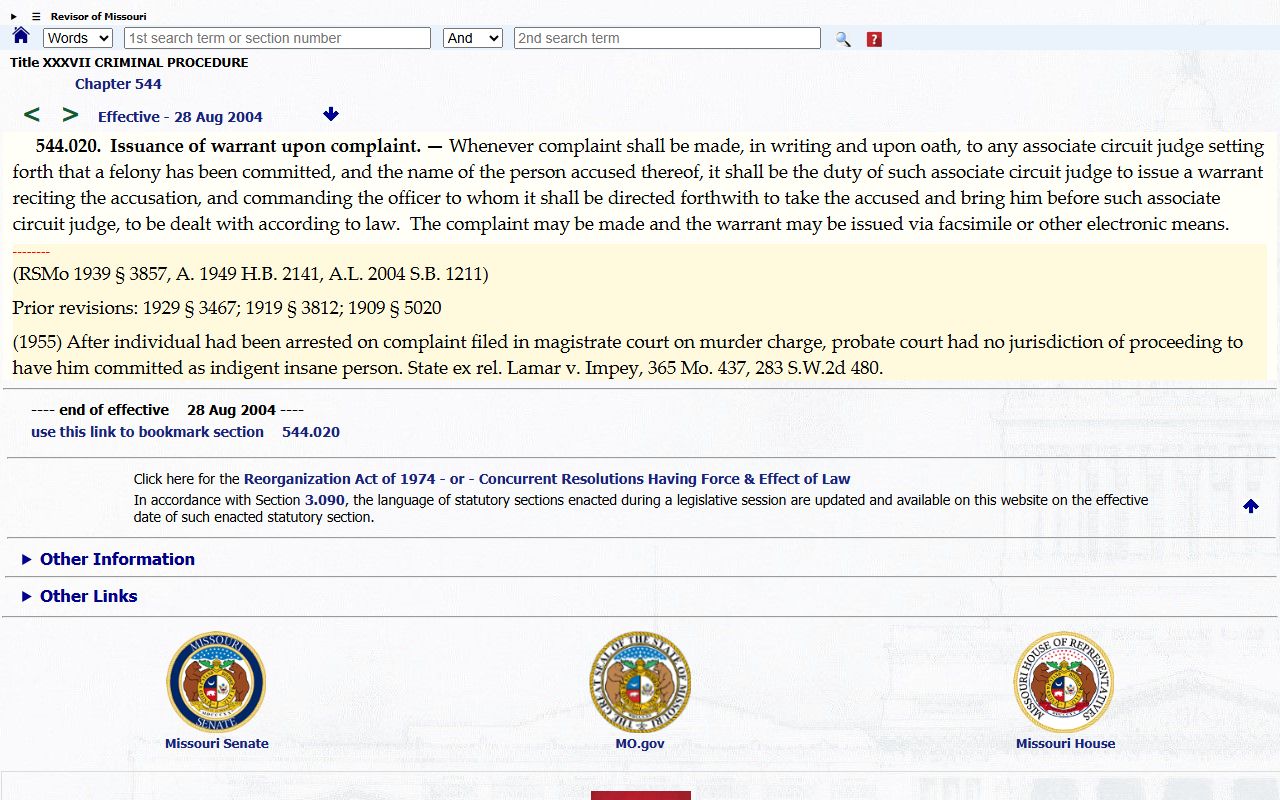
That statute helps connect the arrest-to-charges path: facts lead to a complaint or warrant request, and the court record begins when the charging document is filed.
| Complaint | Information | Indictment | |
|---|---|---|---|
| Filed By | Officer or prosecutor based on alleged facts. | Prosecutor. | Grand jury. |
| Common Role | Starts criminal process or supports warrant review. | Formal prosecutor-filed charge in many cases. | Formal accusation in selected serious matters. |
| Where It Appears | May support the court case, warrant, or first appearance. | Appears in the court case as the filed charge. | Appears in the court case if returned. |
Osage County Prosecutor Review
The Osage County Prosecuting Attorney is the key office for charges after arrest. An arresting agency can present facts, reports, witness statements, probable cause information, and booking details, but the prosecutor decides whether to file, decline, amend, or negotiate formal criminal charges in court. That decision is why arrest records and court charge records must be read separately.
Prosecutor records and defense services are not the same as the public court docket. The research identifies the Missouri State Public Defender's Jefferson City District 19 office as the nearby public defender contact for many central Missouri defendants, depending on court, eligibility, and case type. The manifest also assigns the Federal Defender Jefferson City office as a defense-resource image for the broader charge and representation context.
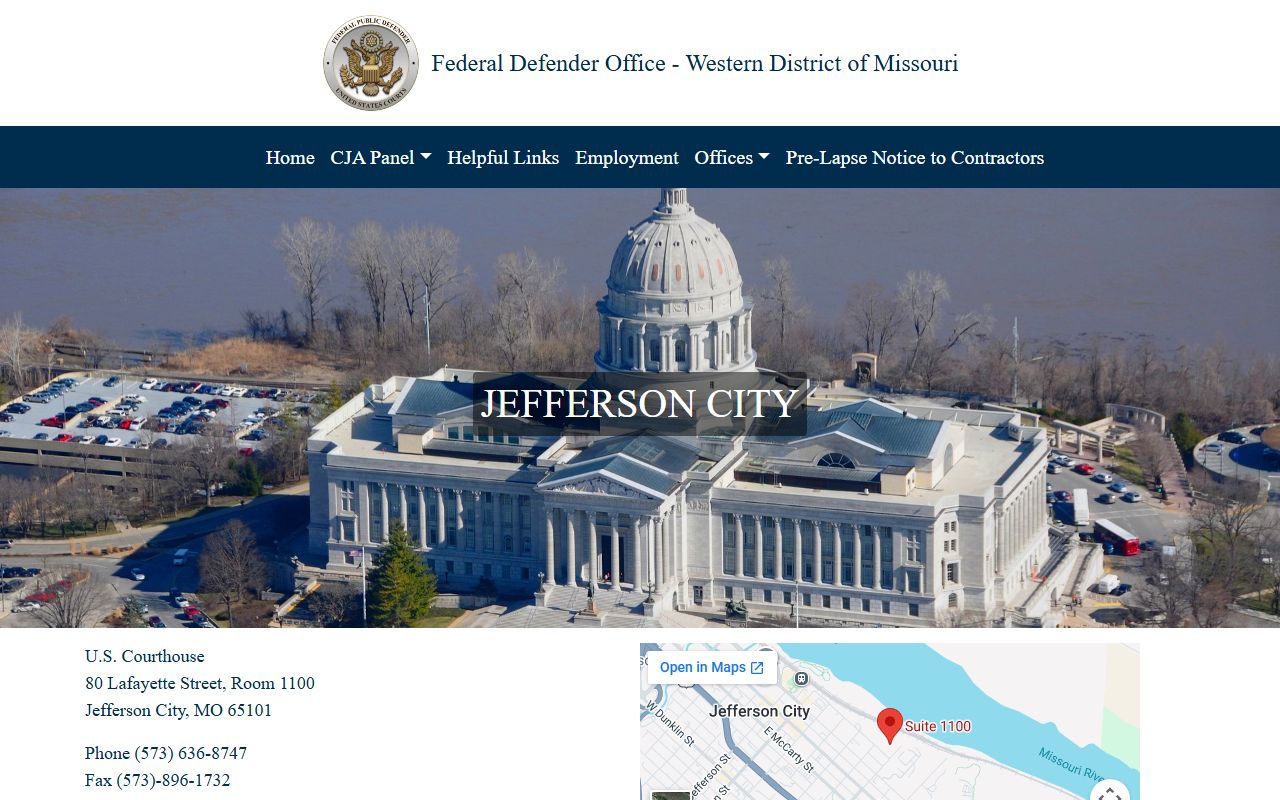
Defense-office references help explain representation channels, but state charges after arrest in Osage County are still filed and tracked through the Missouri court case.
Osage County Prosecuting Attorney
106 East Main Street, P.O. Box 378
Linn, MO 65051
(573) 897-3101
Monday-Friday, 8:00 a.m. to 4:30 p.m.; closed major holidays
Amanda.Grellner@prosecutors.mo.gov
Osage County Charge Status
A charge record is not fixed at the moment of arrest. One arrest can lead to no filed case, one filed count, or several filed counts. A filed count can be amended, reduced, dismissed, replaced by a plea count, or resolved by trial. Case.net and the Circuit Clerk's file are the places to check the current court status after filing.
| Status | What It Means |
|---|---|
| Pending | The charge has been filed and has not reached final disposition. |
| Amended / Reduced | The prosecutor or court record shows the count changed from the original filed charge. |
| Dismissed | The court ended that charge without conviction on that count. |
| Nolle Prosequi | The prosecutor declines to pursue that count or case further, when reflected in the record. |
| Disposed | The count has a final result, such as guilty plea, conviction, acquittal, dismissal, or other outcome. |
Note: Check each count separately because a single Osage County case can have different outcomes for different filed charges.
Charges vs Convictions
A charge after arrest is an accusation filed or pursued in court. A conviction is a result after a guilty plea, verdict, or court finding. Osage County charge records can show allegations that never became convictions, and a conviction can be for a reduced or amended count rather than the first booking charge.
| Charge | Conviction | |
|---|---|---|
| Stage | Accusation or filed count. | Final guilty outcome after plea or trial. |
| Proof Level | Probable cause and charging review. | Guilty plea, verdict, or court finding. |
| Record Meaning | Shows what was alleged or filed at one point. | Shows the court's resolved offense. |
| What Can Change | Can be amended, reduced, added, dismissed, or replaced. | Can lead to sentence, probation, fines, costs, or restitution. |
Sealed vs Expunged Charges
Some arrest records and charge records are not open to the general public. Juvenile records are generally closed under RSMo 211.321. Eligible criminal records may be expunged by petition under RSMo 610.140. Public identifiers, protected addresses, medical details, financial account numbers, confidential informants, and safety-sensitive investigative information can be redacted or withheld.
| Sealed | Expunged | |
|---|---|---|
| Public Access | Closed or limited by law, rule, or court order. | Removed from public access after an eligible petition is granted. |
| Record Location | The record may still exist with the agency or court. | The court record is restricted from ordinary public search. |
| Typical Examples | Juvenile, adoption, mental health, active investigative, or safety-related records. | Eligible Missouri criminal matters subject to exclusions and waiting periods. |
| How to Verify | Ask the court or records custodian whether an order controls access. | Use the court where the person was charged or found guilty. |
Osage County Charge Codes
Charge entries can include statute numbers, ordinance numbers, class levels, count numbers, and short offense descriptions. Missouri criminal charges may appear as felonies or misdemeanors, while municipal matters may cite a city ordinance. Traffic charges can be state-law traffic cases, municipal ordinance cases, or criminal matters when the offense is more serious.
One arrest can produce several separate charges. A court record may list count one, count two, and later amended counts. Dismissed counts can remain visible unless restricted. Plea entries and dispositions should be checked after the charge list, because the final court result may not match the first count displayed.
- Booking charge
- The law-enforcement label tied to arrest or custody intake.
- Filed charge
- The formal count filed in court by complaint, information, or indictment.
- Amended charge
- A filed count changed during the court case.
- Disposition
- The outcome of a charge or case.
Statewide Criminal History Limits
Statewide criminal-history checks and local court-charge lookups serve different purposes. Case.net can show public Missouri court case activity, but it is not the same as a full criminal-history report. Sheriff arrest reports are law-enforcement records. Prosecutor charging decisions are court-filed counts after filing. State supervision or prison custody belongs to Missouri Department of Corrections sources, not the county jail.
For Osage County arrest and charge work, the most reliable official sequence is sheriff or jail for booking and arrest information, Prosecuting Attorney and Circuit Clerk for filed charge questions, Case.net for public docket review, and the Circuit Clerk for certified court copies. Avoid treating third-party arrest sites as official county records.
Background Check Considerations
Casual lookup of arrest records and court charges is not the same as an FCRA-compliant background check. A public charge record may show an accusation, not a conviction. A booking entry may predate charging review. A court case may include dismissed counts, amended charges, or an expunged record that no longer appears publicly.
Important: Arrest and charge lookup data is not a consumer report and should not be used for FCRA-regulated decisions.
Restricted Osage County Charge Records
Restricted charge records include juvenile cases, sealed cases, expunged cases, active investigative material, and records withheld for safety or privacy reasons. A missing public result does not prove that no arrest or charge occurred. It may mean the case is sealed, expunged, filed under a different name or case number, held by another court, still under review, or outside the court system entirely.
The Circuit Clerk can address court-file questions, while the Sheriff's Office handles arrest and incident reports. If the matter involves a municipal ticket or city ordinance, contact the municipal division that issued the citation. Osage Beach Municipal Court is a separate local channel for city-code and municipal traffic cases.